
Elevent Index Academy / 60 to 90 minutes / facilitator-led
Good
business.
Two different questions, routinely confused. Learn to separate Investment Quality from Funding Readiness, score both from evidence, and read the pattern before you write the cheque.
What is Elevent Index Academy?
Elevent Index Academy introduces the Elevent Index framework by Dr. Bitan Ghosh to founders, investors, accelerators and ecosystem professionals. Free lessons and a facilitator-led, 60 to 90 minute workshop explore 11 Investment Quality and 5 Funding Readiness dimensions, stage-sensitive weighting across five maturity stages, and the Capital Readiness Score, CRS = (7 x IQS) + (3 x FRS), read on a 5 x 5 matrix.
Explore the Elevent Index framework websitePoke it
Which one is the problem?
Drag the two scores. Watch how little polish can do for a weak business, and how much a weak business costs you.
65.0
Attractive, underprepared. Fix the paperwork.
Six questions the workshop answers
What you will be able to answer
- 01 / The two questions
Is my startup actually ready to raise funding?
Separate business quality from fundraising preparation using Investment Quality Score (IQS) and Funding Readiness Score (FRS).
Open the lesson - 02 / Evidence, not intuition
What will investors look for beyond my pitch deck?
Explore the 11 Investment Quality and 5 Funding Readiness dimensions, and the evidence that supports each score.
Open the lesson - 03 / Stage-sensitive scoring
How should I assess my startup at its current stage?
Apply the weights for five maturity stages so expectations match your startup’s level of development.
Open the workshop - 04 / Hands-on live inputs
How do I calculate my capital readiness score?
Enter your own dimension values live and calculate CRS = (7 × IQS) + (3 × FRS), on a 100-point scale.
Open the workshop - 05 / From diagnosis to action
What should I fix before approaching investors?
Read the 5 × 5 Capital Readiness Matrix, identify gaps in quality or readiness, and prioritise improvements.
Open the lesson - 06 / Judgment and limitations
Does a strong score guarantee that I will get funded?
No. Scores guide human judgment; the workshop explains red flags, self-scoring bias and why diligence still matters.
Take the knowledge check
Learning objectives
By the end you can...
- 1
Differentiate Investment Quality (business substance) from Funding Readiness (process preparedness).
- 2
Apply the 11 IQS and 5 FRS dimensions to judge a startup on evidence, not intuition.
- 3
Calculate and interpret the Capital Readiness Score with stage-sensitive weighting.
- 4
Diagnose readiness gaps on the 5x5 Capital Readiness Matrix and prescribe fixes.
Who it is for
Four seats at one table
Founders
Self-diagnose before the first pitch.
Investors
Structure the gut feel behind a pass or a yes.
Accelerators
Prescribe the right work to the right cohort company.
Ecosystem professionals
Share one vocabulary across mentors, funders and advisors.
Session plan
Seven movements, about 85 minutes
The book
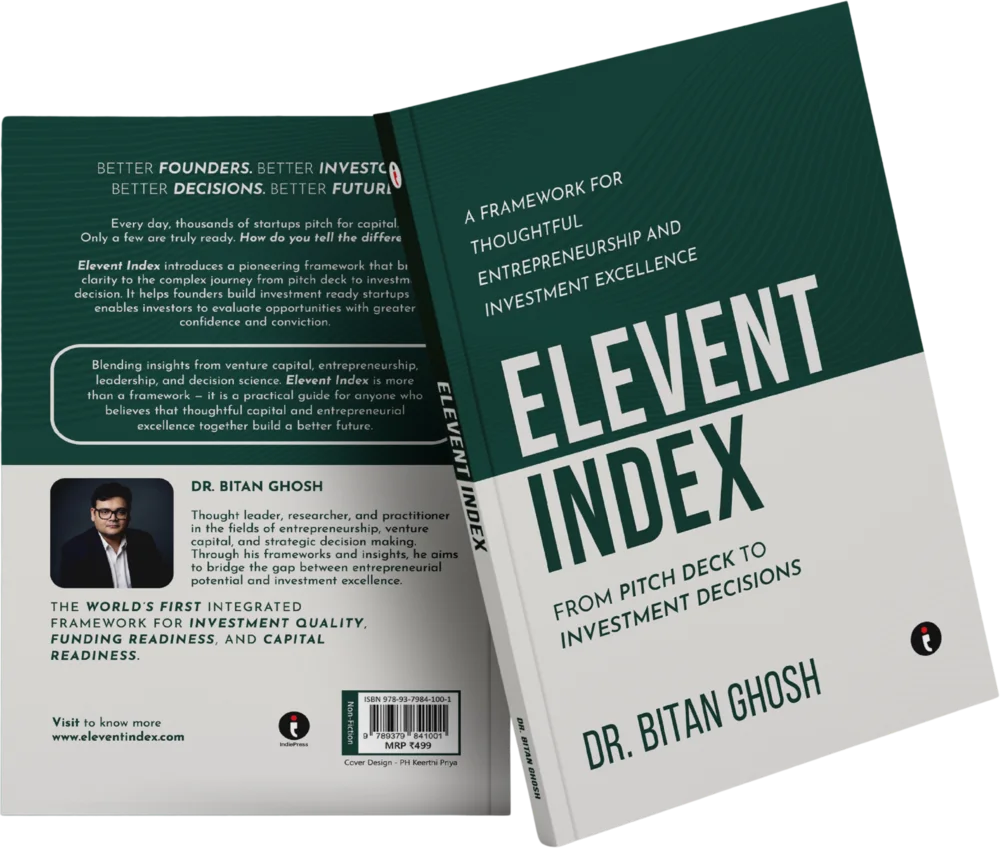
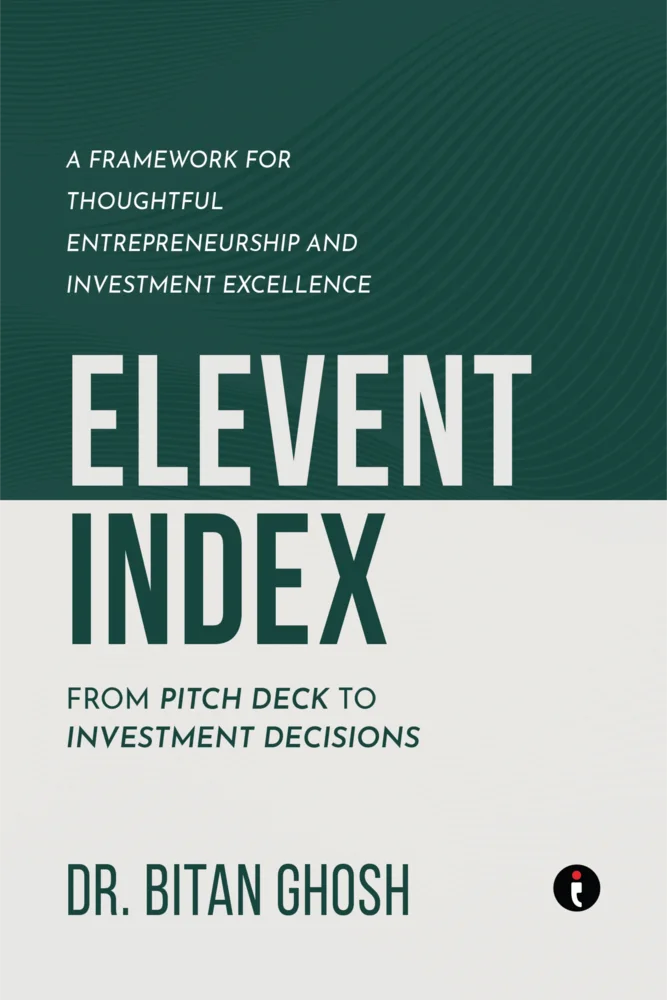
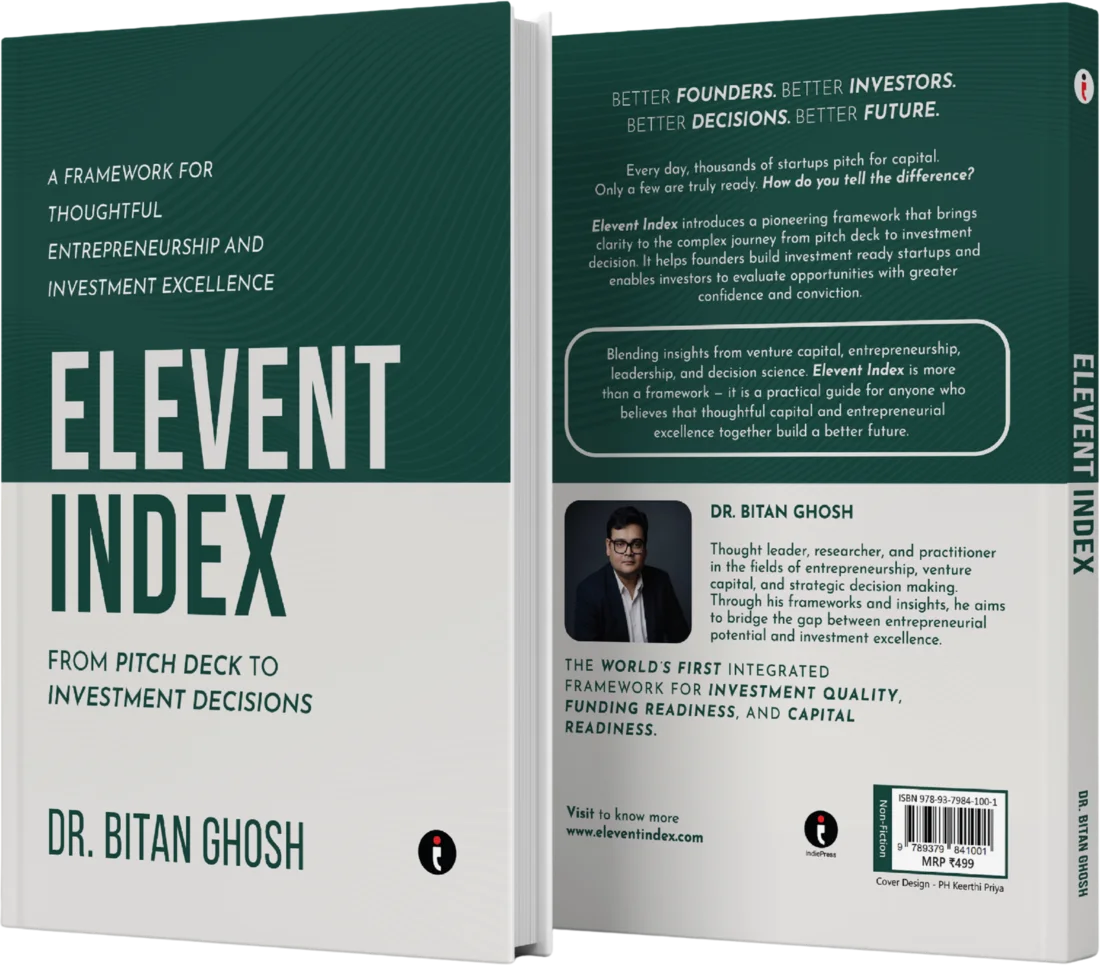
Elevent Index: From Pitch Deck to Investment Decisions
28 chapters in six parts, plus eleven appendices. 11 Investment Quality and 5 Funding Readiness dimensions, built on 160 evidence-based subparameters, 5 maturity stages and a capital readiness matrix.
Includes the philosophy, full scorecards, sector playbooks, and the methodology and validation behind them.

About the author
Dr. Bitan Ghosh
Entrepreneur, investor, business strategist and creator. His career spans infrastructure, technology, consulting and business leadership, connecting entrepreneurial ambition with evidence-based investor judgement.
B.Tech Civil Engineering, MBA International Business and Finance, DBA Finance, Chartered Engineer (India).
LinkedInAcademy live scoring
Input your own values
Get an instant IQS, FRS and CRS. Optional numerical scenarios are there for reference only.
Open live scoringFAQ
Fair questions
What is Elevent Index?
Elevent Index is a startup assessment framework by Dr. Bitan Ghosh, presented in the book Elevent Index: From Pitch Deck to Investment Decisions. It separates Investment Quality, the substance of a business, from Funding Readiness, its preparation for the fundraising process. These two assessments produce the Investment Quality Score (IQS) and Funding Readiness Score (FRS), which combine into the Capital Readiness Score (CRS). The Capital Readiness Matrix keeps both scores visible so that business strengths are not confused with fundraising preparation. Elevent Index Academy provides an introductory learning and scoring experience, not the full certified assessment.
What is Investment Quality Score (IQS)?
Investment Quality Score (IQS) assesses whether a startup has business substance that deserves capital. It covers 11 dimensions, including founder and leadership strength, market opportunity, product and innovation, business model viability, financial strength, customer and growth indicators, and governance. Each dimension normally averages ten evidence-rated sub-parameters on a 0–10 scale. Stage-specific dimension weights produce an overall IQS on a 0–10 scale. IQS contributes 70% of the combined Capital Readiness Score, but should also be read separately from Funding Readiness Score: strong pitch preparation cannot compensate for weak business evidence. The Academy workshop accepts dimension averages directly for illustrative practice.
What is Funding Readiness Score (FRS)?
Funding Readiness Score (FRS) assesses how prepared a startup is to run and complete a fundraising process. Its five dimensions are Financial Readiness, Legal and Governance Readiness, Fundraising Strategy Readiness, Due Diligence Readiness, and Transaction Readiness. Each dimension normally averages ten evidence-rated sub-parameters; stage-specific weights combine the dimension scores into an FRS on a 0–10 scale. FRS contributes 30% of the Capital Readiness Score. It answers a different question from Investment Quality Score: a business can have strong potential but incomplete documentation, or polished fundraising materials without strong business substance. Read both axes in the Capital Readiness Matrix before deciding what needs improvement.
How is Capital Readiness Score (CRS) calculated?
Capital Readiness Score (CRS) is calculated as CRS = (7 × IQS) + (3 × FRS). Investment Quality Score (IQS) and Funding Readiness Score (FRS) each use a 0–10 scale, so CRS uses a 0–100 scale. The formula gives business quality 70% of the combined score and fundraising preparation 30%; maturity-stage weights apply within IQS and FRS before they are combined. In the Academy live workshop, enter all 11 IQS and five FRS dimension scores for a complete result. An incomplete subtotal is provisional, not a finished assessment. Interpret the resulting CRS alongside both axes of the 5 × 5 Capital Readiness Matrix, not as a funding guarantee.
Does the Index replace investor judgement?
No. Elevent Index structures investor judgement rather than replacing it. Investment Quality Score (IQS), Funding Readiness Score (FRS), and the Capital Readiness Matrix help identify where a startup appears strong, where evidence is incomplete, and what deserves further investigation. Investors still need to verify the underlying evidence and perform financial, legal, commercial and other relevant due diligence. A numerical score cannot establish that a claim is true or that an investment fits an investor’s objectives. Use the framework to organise questions and focus review, not to approve or reject a startup mechanically. The Academy’s introductory exercises are not a substitute for professional assessment.
Should founders score themselves or get outside review?
Both are useful for different reasons. Founder self-assessment with Elevent Index builds awareness of business-quality gaps and fundraising-preparation gaps before approaching investors. An outside review tests whether the evidence supports the scores and helps challenge optimistic assumptions. For a meaningful comparison, reviewers should use the same maturity stage and explain the evidence behind each dimension rating. If scores differ, investigate the reason instead of simply averaging away the disagreement. The Academy workshop can support this discussion by keeping Investment Quality Score (IQS) and Funding Readiness Score (FRS) separate. Self-entered workshop results remain illustrative and should not be presented as a certified Elevent Index assessment.
Is one low dimension an automatic rejection?
No. A low Elevent Index dimension score is a signal to investigate, not an automatic investment decision. Read the weakness alongside the other Investment Quality or Funding Readiness dimensions, the startup’s maturity stage, and the evidence supporting the rating. Stage-specific weights change how much that weakness contributes to IQS, FRS and the combined Capital Readiness Score. A low score may reflect missing evidence, an early-stage limitation or a substantive business risk; those possibilities need different responses. Serious weaknesses still deserve attention even when the overall CRS is high. Use the Capital Readiness Matrix and due diligence to understand the issue rather than treating a single number as a universal rejection rule.
Does a high CRS guarantee funding?
No. A high Capital Readiness Score (CRS) indicates assessed readiness under the Elevent Index framework, not a guaranteed fundraising outcome. CRS combines Investment Quality Score (IQS) and Funding Readiness Score (FRS), but the result depends on the underlying evidence, dimension ratings and maturity-stage assumptions. An investor must still verify the business and decide whether it fits their investment objectives and risk appetite. Read the Capital Readiness Matrix as well as the combined score, because a single total can conceal different quality and preparation gaps. Academy workshop scores are illustrative learning inputs, not a promise of funding or a replacement for due diligence.
When should a startup be reassessed?
Reassess a startup with Elevent Index at meaningful milestones when its evidence has genuinely changed. Relevant changes may include new product validation, paying-customer evidence, a different revenue pattern, improved financial reporting, completed legal documentation or movement into another maturity stage. Update the affected dimension ratings and check whether the selected stage and its weights still fit before recalculating Investment Quality Score (IQS), Funding Readiness Score (FRS), and Capital Readiness Score (CRS). Keep a record of the stage, evidence and assumptions used so that changes in results can be explained. Do not treat an old score as a permanent label or repeatedly rescore unchanged evidence just to obtain a higher number.
What if the stage is unclear?
Use judgement to select the maturity stage that best matches the startup’s current evidence, not its ambitions for the next funding round. Elevent Index uses five stages: Idea / Pre-Seed, MVP / Pilot, Early Revenue, Growth, and Scale-Up / Pre-IPO. If the evidence falls between neighbouring stages, start with the more conservative stage and run a sensitivity check using the neighbouring stage. Compare how the stage-specific weights affect Investment Quality Score (IQS), Funding Readiness Score (FRS), and Capital Readiness Score (CRS). Explain why the stage is uncertain and what evidence would resolve that uncertainty. Choosing a stage only because it produces a more attractive score would weaken the assessment.
Is the score the end of the process?
No. The Elevent Index score is a starting point for interpretation and action. After calculating Investment Quality Score (IQS), Funding Readiness Score (FRS), and Capital Readiness Score (CRS), read the 5 × 5 Capital Readiness Matrix to understand how business substance and fundraising preparation interact. Examine the dimension-level evidence, identify the most important gaps, and decide what to validate or improve next. The Academy workshop highlights weighted CRS drag to support that discussion, but a numerical priority does not replace judgement about serious risks. Take action, gather better evidence and reassess at meaningful milestones. A final investment decision still requires human judgement and appropriate due diligence.